
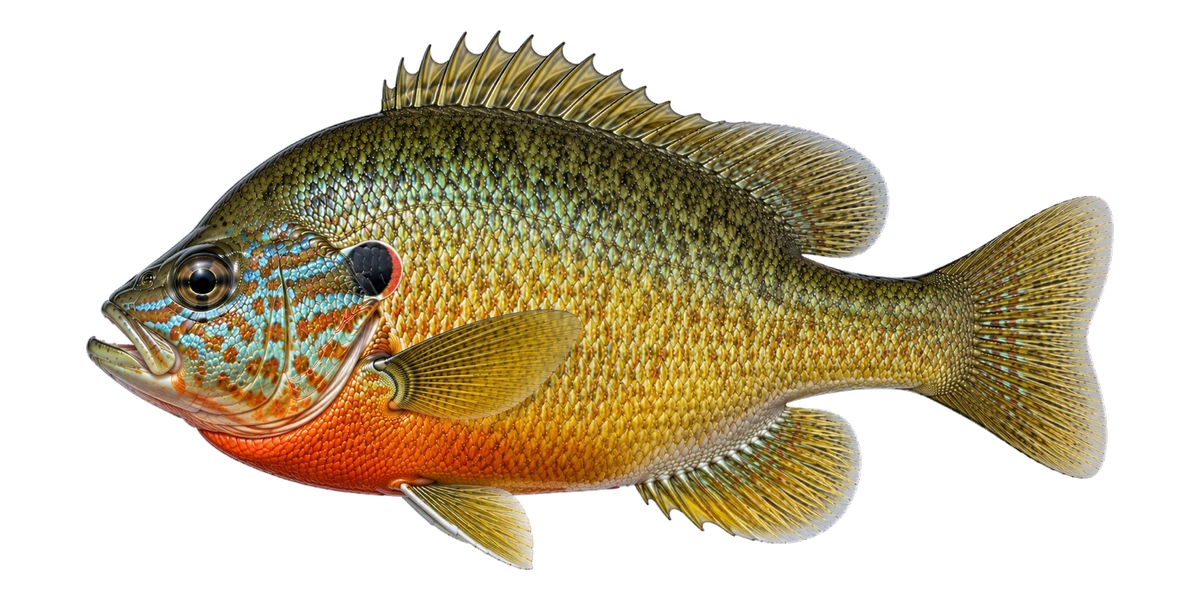
Pumpkinseed Fishing at Lake Hartwell
Lepomis gibbosusCentrarchidae · Vegetation-oriented panfish and sport sunfish
Pumpkinseed are colorful sport panfish that live around vegetation, shoreline cover, backwaters and shallow sand or gravel. They feed heavily on aquatic insects, snails, small mussels and crustaceans, and their throat teeth let them crush hard-shelled prey that many anglers never think of when choosing a presentation.
Start with the clues that concentrate fish
Look here
Pumpkinseed often live in small, food-rich pockets rather than roaming huge areas. Vegetation edges, holes and transitions become especially useful when they also hold snails, insects or small crustaceans.
Follow the food
Their diet is unusually tied to bottom and vegetation-associated invertebrates. Match small prey and keep presentations compact because Pumpkinseed have relatively small mouths.
How to fish for them
Use compact worms, insect-sized baits or other legal small natural offerings around vegetation edges and shallow cover.
Use small jigs, micro-plastics and other tiny invertebrate-style presentations close to vegetation and bottom transitions.
Work edges, holes and isolated pockets instead of fishing a large weedbed as if every section is equal.
Search suitable shallow sand or gravel near cover, then expand around the surrounding nesting area rather than focusing on one fish.
Vegetation can hold snails, insects and other prey that Pumpkinseed are well equipped to eat.
Shallow sand or gravel becomes more important during the spawning period.
Openings, edges and transitions inside vegetation can concentrate prey and make precise light-tackle fishing more effective.
Pumpkinseed often forage close to the bottom for snails, mussels and other invertebrates.
Where several Lepomis species occur together, identification matters because Pumpkinseed can be confused with Redear and other sunfish.
Fast facts worth remembering
- Scientific identity
- Lepomis gibbosus
- Family
- Centrarchidae — the sunfish family
- Main foods
- Snails, mussels, insects and crustaceans
- Special feeding tool
- Pharyngeal teeth that crush hard prey
- Typical habitat
- Vegetated margins and shallow cover
- Identification caution
- Do not confuse with Redear Sunfish by color alone
Facts that change how you think on the water
Their teeth are in the throat
Pumpkinseed use molar-like pharyngeal teeth to crush hard prey such as snails and small mussels after swallowing them.
Vegetation is food habitat, not just cover
Pumpkinseed use vegetated margins where aquatic insects, snails and small crustaceans are abundant.
Small mouth means small presentation
Pumpkinseed are small-mouthed sunfish that feed heavily on compact invertebrate prey.
Identification matters in mixed sunfish water
Pumpkinseed can resemble Redear and other sunfish, especially when anglers rely only on ear-flap color or general body color.
A seasonal behavior, not a magic temperature
Pumpkinseed spawn in warm shallow water, with males building and guarding nests on suitable sand, gravel or mixed bottom near cover.
Fishing use: During the spawning period, check shallow sand and gravel near vegetation and shoreline cover, then search the surrounding nesting area for additional fish.
Keep in mind: A spawning threshold is not a year-round feeding temperature, and exact timing varies by lake and local warming.
Three facts that stick
Molar-like pharyngeal teeth let Pumpkinseed break snails and small mussels after the prey is swallowed.
Male Pumpkinseed build nests and protect eggs and early young.
A strange-looking Lepomis in mixed sunfish water may genuinely have mixed ancestry.
Find vegetation with something to eat in it.
Pumpkinseed are small sport fish with a specialized appetite. Vegetation, shallow cover and bottom pockets become much more useful when they also hold snails, insects, mussels or small crustaceans.