
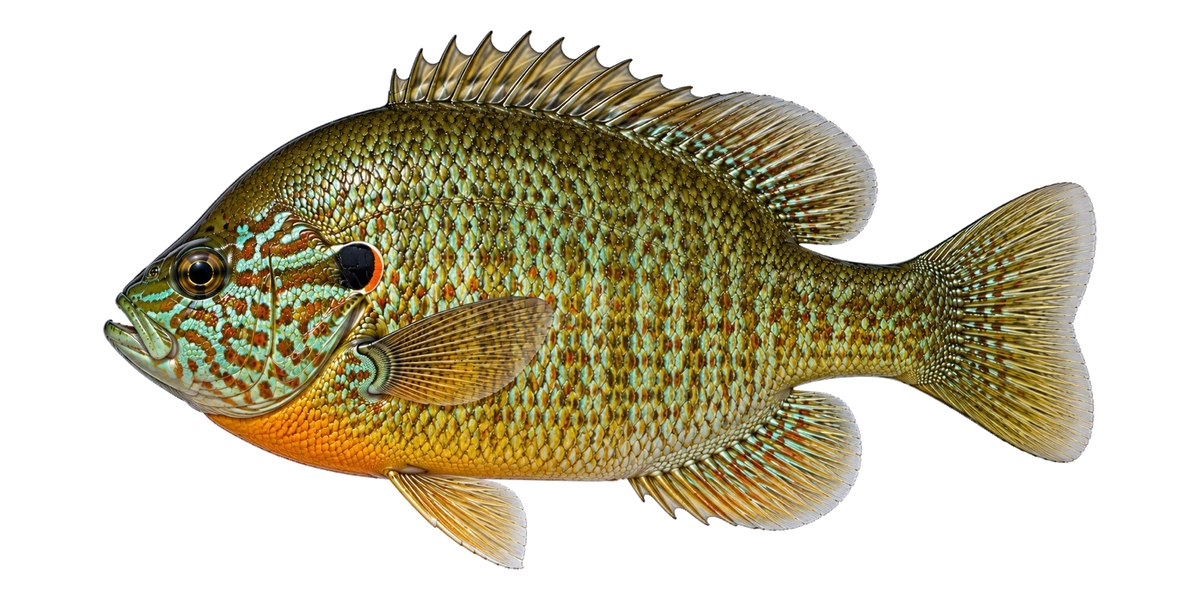
Redear Sunfish / Shellcracker
Lepomis microlophusCentrarchidae · Large panfish and specialized bottom-feeding mollusk predator
Redear Sunfish are serious panfish built around the bottom food web. Their nickname “Shellcracker” is unusually accurate: specialized pharyngeal teeth farther back in the throat let them crush snails and other hard-shelled prey. That feeding equipment explains much of their fishing pattern—productive bottom, vegetation, mollusks, insect life and seasonal spawning flats matter more than obvious surface activity.
Redear Sunfish Records
Official state records and IGFA current All-Tackle world records. These are not necessarily Lake Fork catches.
Start with the clues that concentrate fish
Look here
A quiet surface does not mean the area is empty. Redear are much more bottom-oriented than Bluegill, so move your attention downward before abandoning otherwise productive habitat.
Follow the food
“Shellcracker” does not mean they eat only shells. Mollusks can be important, but insect larvae and other benthic invertebrates are also legitimate food.
How to fish for them
Small worms, grubs and other natural baits fit the way Redear feed. Keep the presentation close to productive bottom habitat.
Compact jigs and invertebrate-style presentations can be worked slowly along vegetation edges, flats and bottom transitions.
Search suitable sand, gravel or mud flats carefully. Finding one active nest can mean many more fish are nearby.
Stay focused on bottom-oriented habitat instead of assuming the fish are inactive because nothing is showing on top.
Mollusks and insect life can make a productive bottom more important than obvious surface feeding.
Vegetation adjoining sand, mud or gravel gives Redear feeding habitat and useful structure.
In South Carolina, spawning commonly begins as water moves above roughly 70°F. Treat that as a spawning clue, not a universal feeding optimum.
Redear can nest in colonies, so one bedding fish can justify a careful search of the surrounding flat.
The red or orange margin on the dark opercular flap is useful for identification, but combine it with body shape, small mouth and pectoral-fin shape.
A few facts that help on the water
The important teeth are hidden
Redear have specialized pharyngeal teeth farther back in the throat that can crush hard-shelled prey.
A big fish can still want a tiny meal
Redear can grow into impressive panfish even though they have relatively small mouths and commonly feed on small benthic prey.
Productive shellcracker habitat can matter to bigger predators too.
Redear are not just isolated panfish. Vegetation edges, productive flats and spawning colonies can create concentrations of prey-sized sunfish and other life that larger predators may also use.
Vegetation edges
Redear commonly use vegetation adjoining productive bottom habitat.
Spawning concentrations
Redear can form nesting colonies during the spawning period.
Keep in mind: Use Redear concentrations as food-web evidence, not proof that bass or other predators are actively feeding on them right now.
Think from the bottom up.
Redear are one of those fish where understanding the food web can be more useful than chasing visible activity. Vegetation, productive bottom, mollusks and insect life create the habitat; Redear use it, and bigger predators may work many of the same edges.