
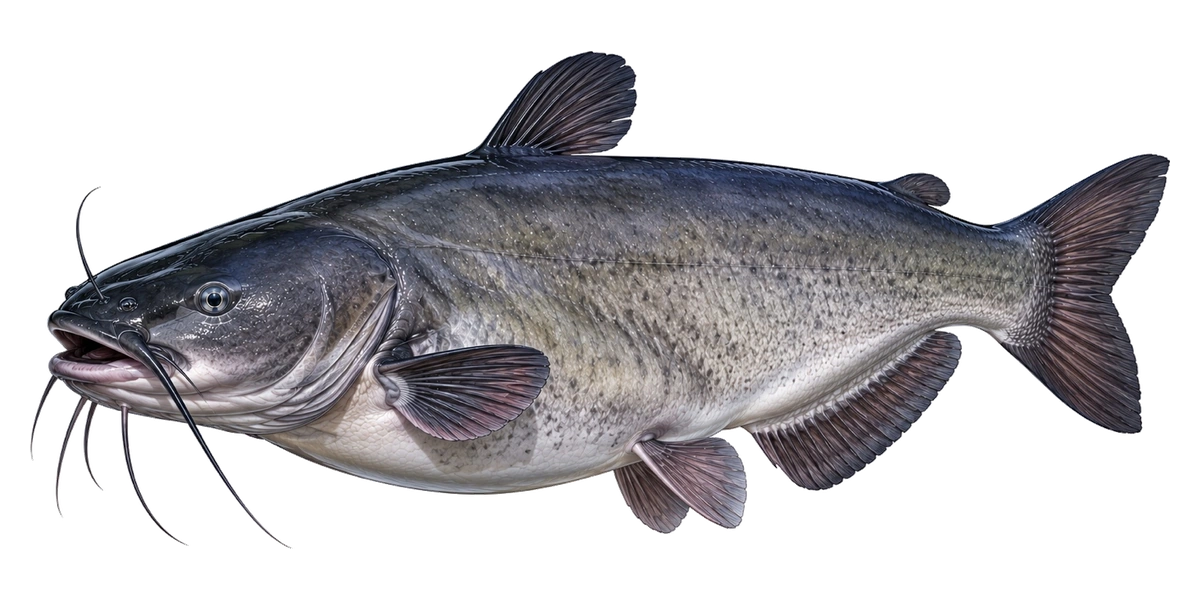
Blue Catfish
Ictalurus furcatusIctaluridae · Large-river and reservoir sport predator
Blue catfish are big-water predators built for rivers, major channels and large reservoirs. They can travel widely, form large aggregations, feed on fish or bottom prey, and occupy open water as well as the bottom. The best blue-catfish fishing usually starts by understanding current, channel geometry, forage and seasonal movement.
Blue Catfish Records
Official state records and IGFA current All-Tackle world records. These are not necessarily Lake Fork catches.
Start with the clues that concentrate fish
Look here
Do not assume a Blue Catfish must be sitting on the bottom. They can suspend, roam and relocate across large areas as forage, flow and seasonal conditions change.
Follow the food
Blue catfish are opportunistic. Fish prey can be important, especially for larger fish, but productive benthic prey such as clams can also matter. The lake's actual food supply should drive bait choice.
How to fish for them
Present fresh locally relevant fish bait where legal around channels, current breaks, forage routes and known fish concentrations.
Drift across channel edges, flats and broad transitions when fish are spread out or moving.
Anchor or hold position and present baits precisely when sonar shows a tight aggregation.
Put the bait at the depth of the fish. Blue Catfish do not have to be on bottom simply because they are catfish.
Main channels, bends, edges and current breaks can guide movement and concentrate food.
Large concentrations of baitfish can pull Blue Catfish into open water or off traditional bottom structure.
Blue Catfish can shift between reservoir regions and depths over the year instead of using one permanent zone.
Large fish or groups showing off bottom are legitimate targets. Match the bait depth to the fish.
Clam- or mussel-rich bottom can be real feeding habitat, so do not assume every productive area must contain visible shad.
A few facts that help on the water
They are not permanently bottom-bound
Blue Catfish use channels, open reservoir water and seasonally changing depths, and they can suspend well off bottom.
Big water means big movement
Blue Catfish are strongly associated with large rivers and reservoirs and can redistribute as current, forage and seasonal conditions change.
Find the channel, then find the food.
Blue Catfish are mobile big-water fish. Use channels and current as the road system, forage and benthic food as the reason to stop, and sonar to decide whether the fish are on bottom or suspended.