
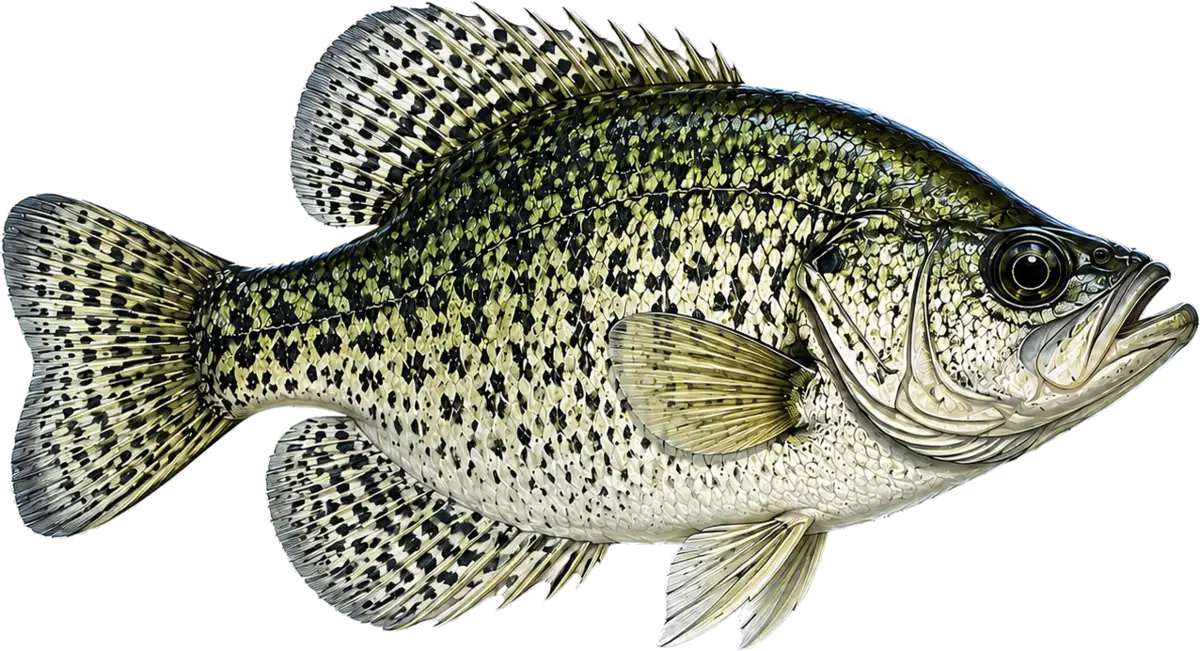
White Crappie Fishing at Sam Rayburn Reservoir
Pomoxis annularisCentrarchidae · Schooling/aggregating panfish and small-fish predator
White crappie are visual predators that commonly use submerged timber, brush, docks and open water near small forage. Compared with black crappie, they are generally more tolerant of turbid water, which helps explain why the two species can dominate different reservoirs.
Start with the clues that concentrate fish
Look here
White crappie can be packed around one piece of cover, suspended beside it, or following forage in open water. Search for the fish's actual depth and position, not just the structure.
Follow the food
Young white crappie feed heavily on zooplankton and insects. Small fish become increasingly important as they grow, so adult fish often track small forage.
How to fish for them
Use small jigs, small minnows where legal, or other compact presentations that can be worked precisely around cover.
Use vertical presentations and match the depth of the fish rather than automatically fishing the bottom.
Slow trolling or moving small minnow-profile lures can help locate scattered or open-water crappie.
Follow small baitfish concentrations when crappie move away from obvious cover.
Submerged wood can concentrate adult fish into small, repeatable targets.
Crappie do not have to sit on the bottom or touch cover. Feeding fish can suspend around forage.
White crappie are generally more tolerant of turbid conditions than black crappie, though muddy water by itself does not guarantee fish.
Protected shallow areas with suitable nesting substrate become more important during the spawning period.
A localized aggregation can thin out temporarily after repeated catches or heavy angling pressure.
Fast facts worth remembering
- Easy ID clue
- Dark vertical bars on the sides
- Typical dorsal spines
- Usually 6
- Family
- Centrarchidae — the sunfish family
- Habitat difference
- More tolerant of turbidity than black crappie
- Adult food
- Small fish become increasingly important
- Parental care
- Male builds and guards the nest
Facts that change how you think on the water
A brush pile can hold a local crowd
Adult white crappie commonly gather around brush, timber and piers, but fish around cover may form a loose aggregation rather than one tightly coordinated school.
They can leave the wood
White crappie can occupy open water and suspend near forage instead of remaining tight to cover.
The menu changes as they grow
Young white crappie begin with zooplankton and insects, while small fish become increasingly important prey as the crappie grow.
They handle turbid water better than black crappie
White crappie are generally more tolerant of turbid water than black crappie, although local forage, cover and seasonal position still determine where catchable fish concentrate.
A seasonal behavior, not a magic temperature
White crappie spawn in spring. Males build shallow nests in protected areas and guard the eggs and newly hatched young.
Fishing use: Follow the seasonal movement toward protected coves and suitable nesting substrate rather than treating every shallow shoreline as equal.
Keep in mind: Spawning temperature varies across regions and local conditions. Do not turn one temperature range into a universal feeding rule.
Three facts that stick
White crappie usually show vertical dark bars and typically have six dorsal spines; spawning males can become darker.
Male white crappie build the nest and guard the eggs and newly hatched young.
Adults packed around brush or piers may be a localized aggregation of fish using the same habitat rather than one coordinated school.
Find cover. Then check the water beside it.
White crappie often concentrate around wood and other structure, but feeding fish can suspend or move into open water with forage. The fish's depth matters more than the depth of the brush.