
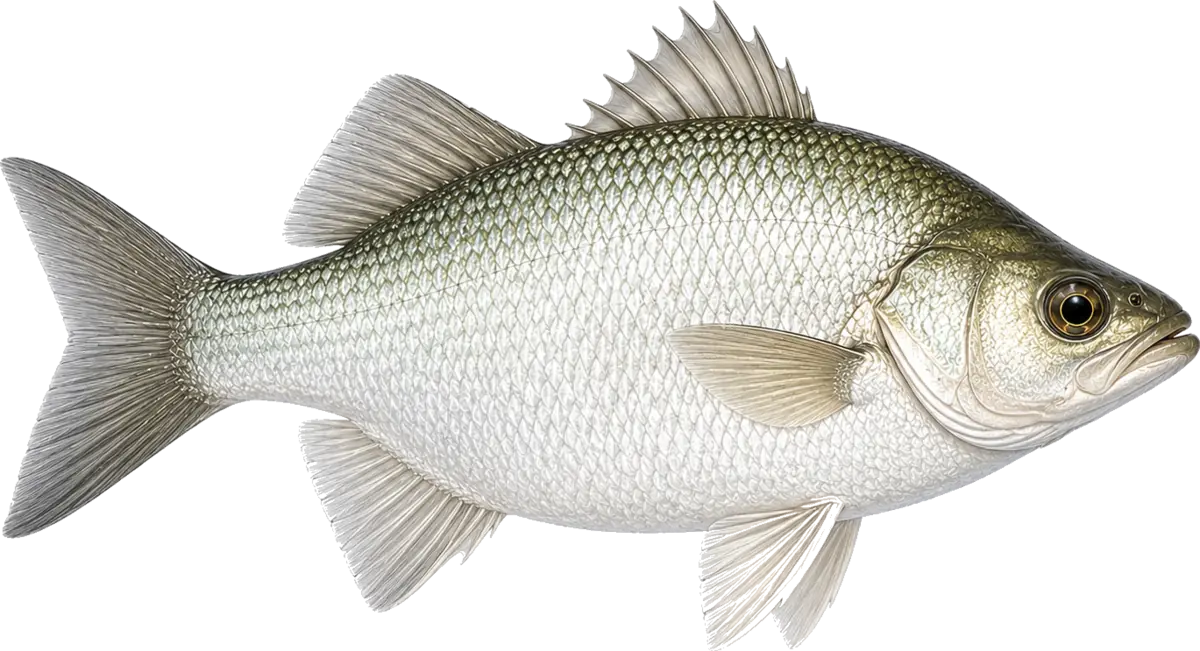
White Perch Fishing at Lake Murray
Morone americanaMoronidae · Schooling temperate-bass panfish and predator
White perch are schooling members of the temperate-bass family, not true perch. Landlocked fish can use open water, points, channel edges and deeper basin structure, while coastal populations may also use brackish water and migrate toward fresher tributaries in spring. Their broad diet makes both small forage fish and invertebrates useful clues.
Start with the clues that concentrate fish
Look here
White Perch can be near bottom or suspended. Use sonar and repeated bites to find the school instead of assigning the species one universal depth.
Follow the food
White Perch are opportunistic. Their menu broadens beyond baitfish, so a small jig, spoon or natural bait can all make biological sense depending on the local food supply.
How to fish for them
Fish small jigs, spoons or legal natural baits vertically at the depth of the fish.
Work points, channel edges and basin transitions when schools are relating to bottom structure.
Keep compact minnow or jig presentations in the actual school depth rather than automatically fishing bottom.
Give tributary, river-influenced and internal reservoir migration routes more attention as spawning approaches.
White Perch school strongly; one bite or one mark can signal many more fish nearby.
Concentrated small fish can pull schools into open water away from obvious shoreline cover.
These transitions can combine travel routes, feeding structure and access to deeper water.
Coastal and landlocked populations are the same species but may use very different routes during spawning season.
Do not force every White Perch school into a bottom-only pattern.
Fast facts worth remembering
- Scientific identity
- Morone americana
- Family
- Moronidae — temperate basses, not true perch
- Behavior
- Strongly schooling
- Diet
- Invertebrates, small fish and fish eggs
- Habitat range
- Freshwater and brackish-water capable
- Spawning style
- Broadcast spawner with adhesive eggs
Facts that change how you think on the water
White Perch are not perch
Despite the common name, White Perch belong to Moronidae with White Bass and Striped Bass, not the true-perch family Percidae.
One bite can reveal a pile of fish
White Perch are strongly schooling and feeding groups can contain many fish.
The same species can live very different lives
Coastal White Perch may use estuaries and move toward fresher tributaries, while landlocked populations complete their lives inside inland waters.
Their diet is broader than a pure baitfish predator
White Perch consume insects, crustaceans, worms, small fish and fish eggs, with diet changing as fish grow and opportunities change.
A seasonal behavior, not a magic temperature
White Perch broadcast adhesive eggs in spring. Coastal fish generally move toward fresh or low-salinity tributary habitat, while landlocked populations make spawning movements within their inland system.
Fishing use: Look for seasonal concentration along the waterbody's actual migration routes rather than assuming a coastal river pattern applies to every reservoir.
Keep in mind: Spawning temperature is a reproductive clue, not a universal feeding temperature; local status and migration routes must remain lake- or watershed-specific.
Three facts that stick
White Perch share the temperate-bass family with White Bass and Striped Bass rather than Yellow Perch.
Landlocked White Perch can complete their entire life cycle inland even though coastal populations also thrive in brackish systems.
White Perch are native to Atlantic coastal drainages but have become established well outside their native range.
Find the school before choosing the depth.
White Perch can be bottom-oriented, suspended or roaming with small forage. Use points and channels to narrow the search, then let sonar, bites and local prey tell you where the school actually is.