
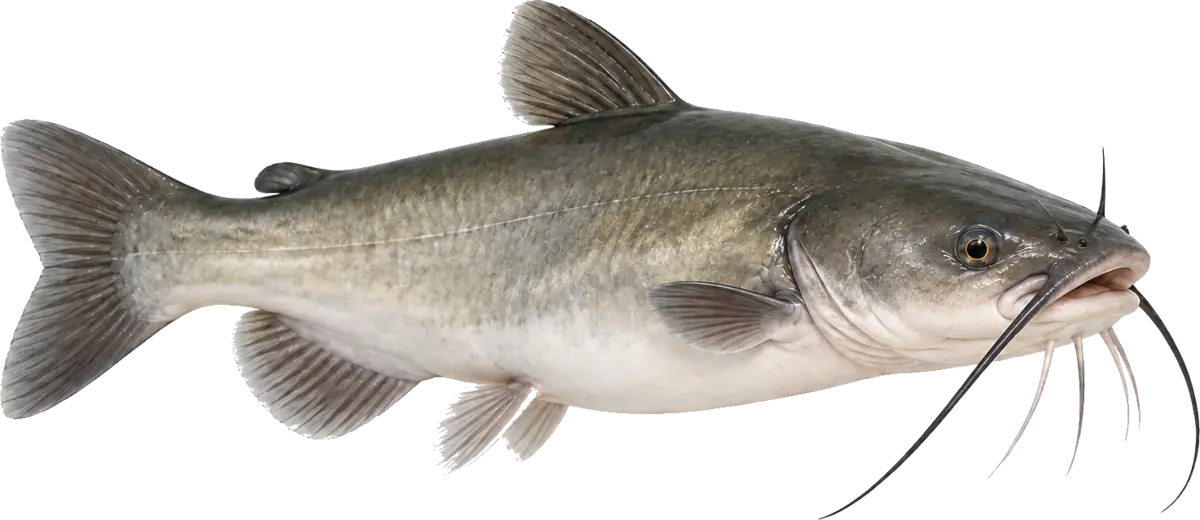
White Catfish Fishing at Lake Monticello
Ameiurus catusIctaluridae · Atlantic-slope bullhead-group sport catfish and opportunistic omnivore
White Catfish are stocky, broad-headed catfish in the bullhead genus Ameiurus, but unlike the familiar square-tailed bullheads they carry a genuinely forked tail. They are most closely associated with slower water, muddy-bottom open water, channels and backwaters, and they feed broadly on invertebrates, fish and plant material. Good White Catfish fishing starts with slow-water habitat, bottom-oriented food and a careful identification check.
Start with the clues that concentrate fish
Look here
Mud and slow water are strong habitat clues, not an absolute rule. Refine the search with channel position, available food and actual fish marks instead of treating every muddy bank as productive.
Follow the food
White Catfish are omnivores, so there is no single universal bait that defines the species. Match presentations to locally available natural food and the size of fish being targeted.
How to fish for them
Use worms, shrimp or other locally appropriate natural baits where legal and keep the presentation close to bottom-oriented feeding zones.
Cut fish or small baitfish profiles can fit the species' diet where legal and where fish prey are part of the local food supply.
A controlled slow drift can cover channel edges, flats and transitions when fish are spread out.
When fish are localized around a channel edge, backwater or bottom transition, hold a bait in the productive zone instead of continuing to cover empty water.
White Catfish commonly use sluggish pools, backwaters, open channels and muddy-bottom areas.
Edges between open channels and slower bottom habitat give fish access to both travel water and food.
Insects, macroinvertebrates, fish and plant material can all be part of the diet, so local food availability matters.
The tail is forked, but with rounded lobes and a shallower fork than the deeply forked look associated with Channel or Blue Catfish.
As water warms into the spawning period, protected sand- or gravel-bank habitat becomes more biologically important.
Fast facts worth remembering
- Scientific identity
- Ameiurus catus
- Family
- Ictaluridae — North American freshwater catfishes
- Best ID combination
- Broad head, pale chin barbels and a moderately forked tail
- Tail
- Moderately or slightly forked rather than deeply forked
- Diet
- Omnivorous — invertebrates, fish and plant material
- Core habitat clue
- Slower open water with muddy bottom, channels and backwaters
Facts that change how you think on the water
It is a bullhead relative with a forked tail
White Catfish belong to the bullhead genus Ameiurus, yet their caudal fin is genuinely but moderately forked.
Slow water matters, but it is not the whole story
Agency profiles place White Catfish in sluggish muddy-bottom pools, backwaters, open channels, freshwater lakes and ponds, and tidal systems.
Their diet is broader than a single catfish bait
White Catfish are omnivorous and can consume terrestrial insects, aquatic macroinvertebrates, fish and plants.
Brackish tolerance is habitat flexibility, not a preference rule
White Catfish occur in both freshwater and mildly brackish coastal waters within parts of their range.
A seasonal behavior, not a magic temperature
White Catfish spawn in early summer as water warms, using still or flowing water near sand or gravel banks. Both parents can fan the bottom into a broad saucer-shaped nest and guard the eggs.
Fishing use: During the spawning period, add protected sand- or gravel-bank habitat and nest-suitable bottom to the search instead of relying only on generic channel patterns.
Keep in mind: The reported 68–72°F spawning range from Maryland is a reproductive cue, not a universal feeding optimum or an exact depth rule for every lake.
Three facts that stick
White Catfish are bullhead relatives, yet their tail is distinctly forked rather than square or rounded.
Maryland fisheries guidance reports that both parent fish fan the bottom to form the saucer-shaped spawning nest.
White Catfish can occupy freshwater and mildly brackish tidal habitat, a useful reminder that their habitat range is broader than an inland mud-bottom stereotype.
Think slow water, bottom food, and a real ID check.
White Catfish are bottom-oriented generalists that favor slower water and muddy-bottom open habitat. Find the channel or backwater, match the local food, and confirm the fish with more than color or a forked tail.