
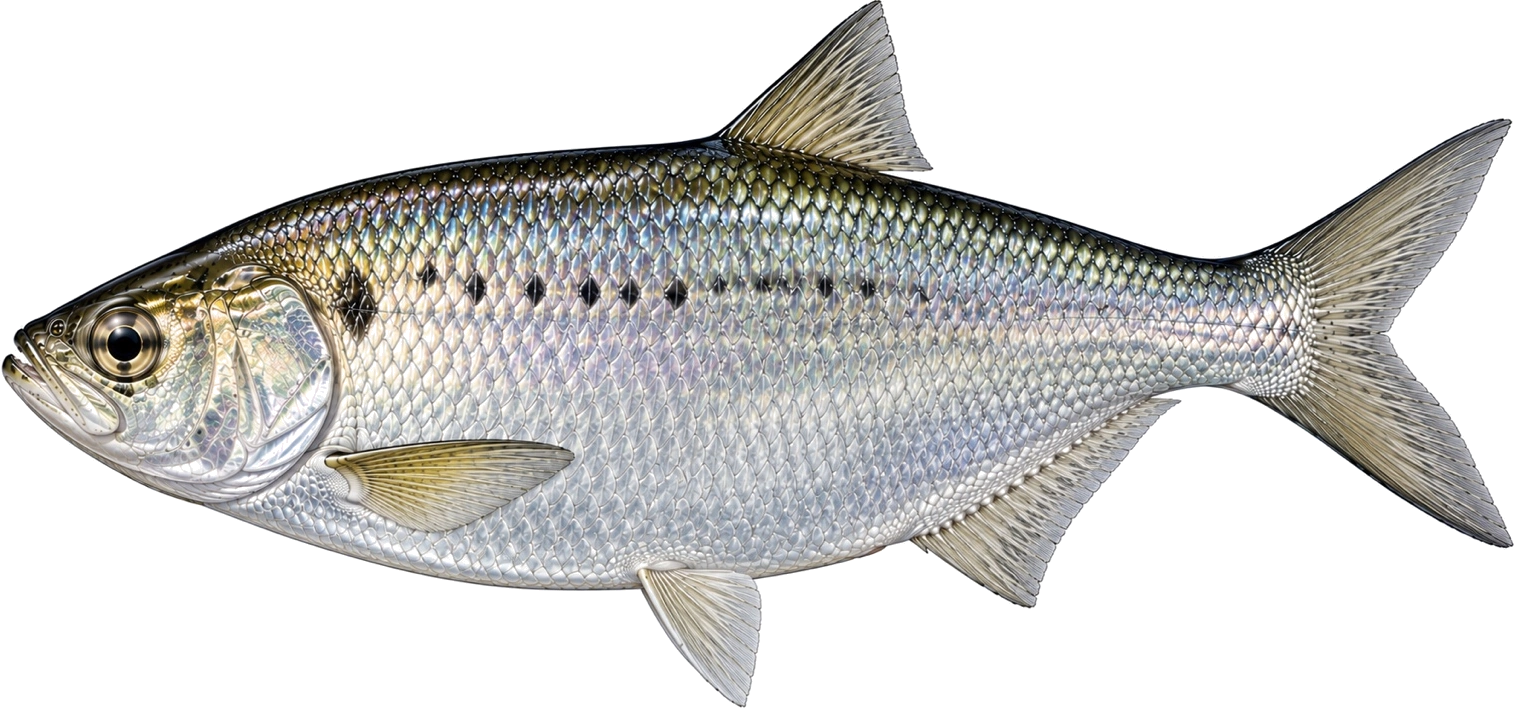
Threadfin Shad Fishing at Lake Monticello
Dorosoma petenenseDorosomatidae · Small pelagic reservoir forage fish
Threadfin Shad are small pelagic forage fish that turn plankton into food for larger predators. Their small body size keeps them vulnerable to a wide range of game fish, and dense schools can move predators far away from obvious shoreline structure.
Use the forage to find feeding predators
Look here
Start with habitat that combines tight schools of very small baitfish, predators feeding on small pelagic forage, and spring shoreline spawning activity around submerged objects. Exact depth and location remain waterbody-specific.
What feeds them
Filter feeder that strains microscopic food from the water with gill rakers. Match the food actually present in the waterbody and season you are fishing.
How to use them as a clue
Use sonar, surface flicker and visible bait concentrations to locate Threadfin Shad before deciding where to fish for predators.
During spawning periods, threadfin can move shallow around vegetation and submerged objects, creating temporary predator opportunities.
Threadfin are small forage. Predator lures that are too large may poorly match what fish are actually eating.
Check above, below and along the edges of the shad school, especially when predators are corralling bait rather than sitting on structure.
Concentrated food can pull Threadfin Shad into a much smaller part of otherwise similar water.
Concentrated food can pull Threadfin Shad into a much smaller part of otherwise similar water.
Spring shoreline spawning activity around submerged objects becomes more useful when it overlaps with food, season, and usable habitat.
Concentrated food can pull Threadfin Shad into a much smaller part of otherwise similar water.
Concentrated food can pull Threadfin Shad into a much smaller part of otherwise similar water.
Fast facts worth remembering
- Scientific name
- Dorosoma petenense
- Family
- Dorosomatidae
- Feeding style
- filter feeder that strains microscopic food from the water with gill rakers
- Primary role
- Reservoir forage fish
- Food
- Phytoplankton and zooplankton
Facts that change how you think on the water
A plankton eater becomes predator fuel
Threadfin Shad use dense gill rakers to strain microscopic plants and animals from the water, turning plankton production into prey that larger game fish can use.
Their small size keeps them useful as forage
Threadfin Shad remain relatively small, which keeps a large portion of the population available to many sizes of predator instead of quickly growing beyond the useful prey window.
Spawning can pull them shallow
Threadfin Shad move into shallow shoreline habitat during warm-season spawning, often around vegetation and submerged objects where adhesive eggs can settle.
The trailing dorsal ray is a serious ID clue
Threadfin Shad show an elongated final dorsal-fin ray, a pointed snout, a projecting lower jaw and often a yellowish tint to the tail and fins.
Use Threadfin Shad to read the predators
When Threadfin Shad concentrates, it can reorganize predator location. Treat the forage itself as moving habitat, then verify which predators are actually using it.
Schools move the target
Threadfin Shad commonly forms moving concentrations.
Season can create a shallow concentration
Warm-season spawning can move Threadfin Shad into shallow shoreline habitat around vegetation and submerged objects.
Usable water matters
Temperature and water quality can reposition forage.
Match the real prey
Predators feeding on Threadfin Shad respond to its real size, shape, speed, and schooling behavior.
Keep in mind: A Threadfin Shad school does not prove a predator is feeding on it at that moment. Confirm predator presence with electronics, visible activity, bites, or other lake-specific evidence.
A seasonal behavior, not a magic temperature
Threadfin Shad spawn during the warmer months in shallow shoreline areas, often around vegetation and submerged objects. Eggs adhere to available substrate rather than being guarded in a nest.
Fishing use: A pelagic forage fish can temporarily become a shallow-water clue during spawning periods, but verify actual bait activity before assuming the pattern is active.
Keep in mind: Do not turn the April–July spawning window into a guarantee of active shoreline spawning on a particular day.
Three facts that stick
Threadfin Shad strain microscopic plants and animals from the water with specialized gill rakers.
Threadfin Shad are less cold-tolerant than many common reservoir fishes, so severe cold can cause stress or die-offs in marginal climates.
Threadfin spawning activity frequently occurs near dawn in shallow shoreline habitat.
Tiny bait can move big predators.
Threadfin Shad may be small, but a dense school can reorganize an entire feeding pattern. Find the bait, match its size and then determine how predators are positioned around it.