
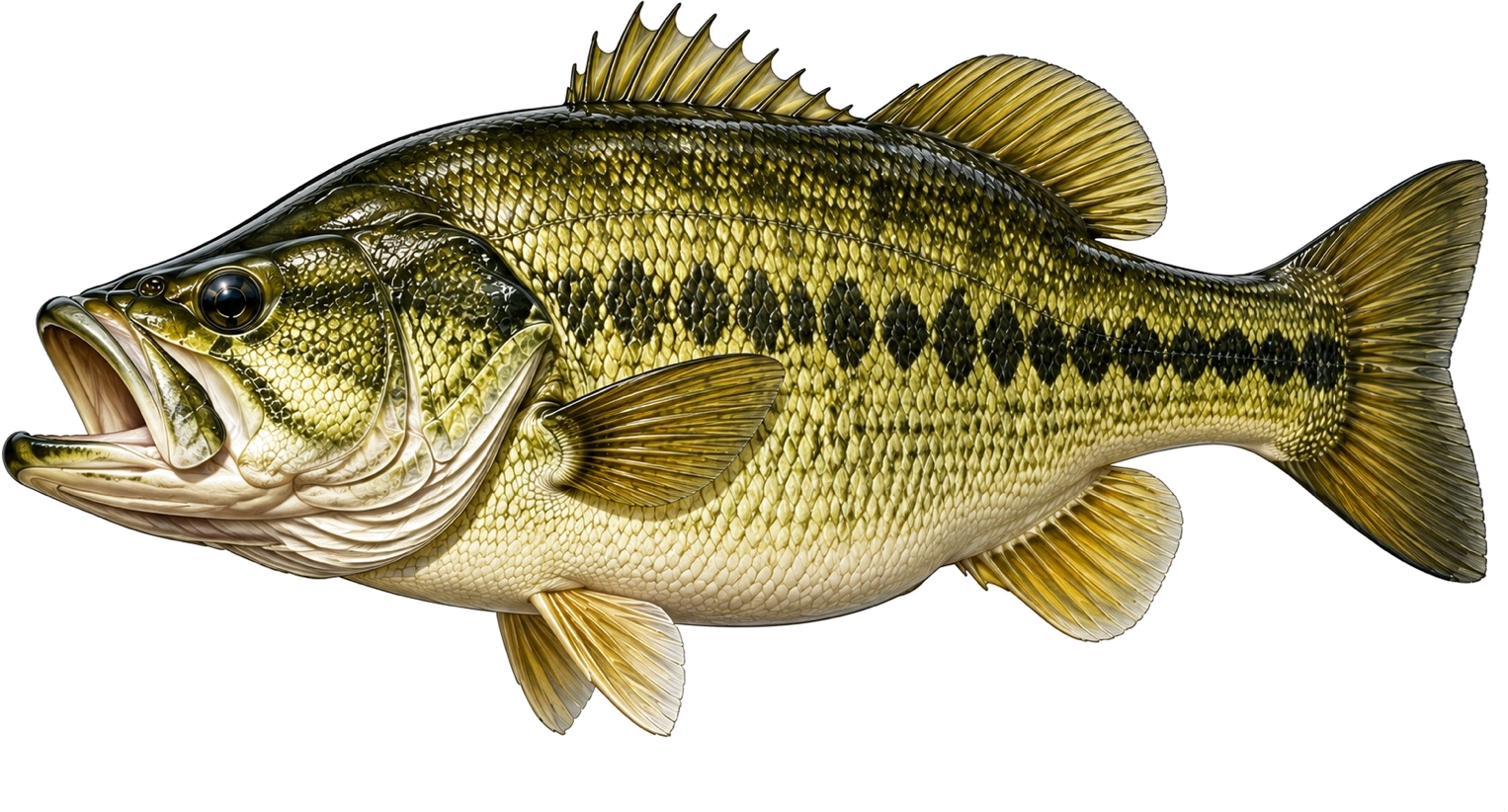
Alabama Bass Fishing at Lake Lanier
Micropterus henshalliCentrarchidae · Black-bass sport predator of rivers and reservoirs
Alabama Bass are aggressive black-bass predators that thrive in rivers and reservoirs, especially around rock, structure and available forage. They were once treated as a form of Spotted Bass, but they are now recognized as a separate species. For anglers, the most useful starting points are rock, offshore structure, current, shad and crayfish—while exact depth and dominant forage remain lake-specific.
Start with the clues that concentrate fish
Look here
Do not fish every Alabama Bass like a shoreline Largemouth. In clear reservoirs especially, deeper rock and offshore structure can be central parts of the fishery.
Follow the food
Alabama Bass can shift heavily between fish prey and crayfish depending on the waterbody. Match the actual food web rather than assuming every population behaves the same way.
How to fish for them
Use baitfish-profile moving baits, suspended-fish presentations and topwater when Alabama Bass are visibly chasing pelagic forage.
Work jigs, soft plastics and other crayfish-profile presentations across rocky points, ledges and bottom transitions.
Use finesse presentations and electronics to work offshore structure when fish are holding below the obvious shoreline zone.
Fish current seams, pools, boulders and woody or vegetated current breaks where food and reduced current meet.
Rocky habitat is one of the most consistent Alabama Bass clues in reservoirs and rivers.
Shad or other pelagic bait can pull Alabama Bass away from the bank and into open or suspended feeding situations.
Where crayfish are abundant, bottom-oriented rock presentations can match an important food source.
Movement increases during the spring transition as fish shift toward spawning habitat.
In river systems, pools and current breaks can concentrate both fish and prey.
Fast facts worth remembering
- Scientific identity
- Micropterus henshalli
- Family
- Centrarchidae — the sunfish family
- Former classification
- Historically treated as Alabama Spotted Bass
- Native range
- Mobile Bay basin
- Core habitat
- Flowing river pools and impoundments
- Important forage
- Fish and crayfish, depending on the waterbody
Facts that change how you think on the water
It is not simply a Spotted Bass with another name
Alabama Bass were historically treated as a Spotted Bass subspecies but are now recognized as the distinct species Micropterus henshalli.
Rock deserves serious attention
Alabama Bass use river pools, impoundments and structurally complex habitat, with rock repeatedly important in reservoir fisheries.
The food source can change the whole presentation
Alabama Bass can feed heavily on fish such as shad, but crayfish can also make up a major portion of the diet in some reservoirs.
Introduced populations can hybridize with native bass
Outside their native range, Alabama Bass have hybridized with other black bass and can alter native populations genetically.
A seasonal behavior, not a magic temperature
Alabama Bass move more during spring and transition toward littoral spawning habitat, where males build and guard nests as other black bass do.
Fishing use: During the spring transition, increase attention to suitable spawning habitat connected to rock, structure and nearby deeper water.
Keep in mind: Spring movement is biologically real, but exact spawning dates, temperatures and depth vary by latitude and reservoir.
Three facts that stick
Alabama Bass spent decades classified as a Spotted Bass subspecies before being recognized as a separate species.
Its native status follows drainage boundaries, not state lines, so an Alabama Bass can be native in one basin and introduced in another.
Introduced Alabama Bass can hybridize with native black bass, allowing their genes to persist long after the original introduction.
Rock first. Then ask what they are eating.
Alabama Bass often reward anglers who combine structure with forage. Find the rock, ledge, current break or offshore structure, then decide whether the fish are feeding on shad, crayfish or another local prey source.