
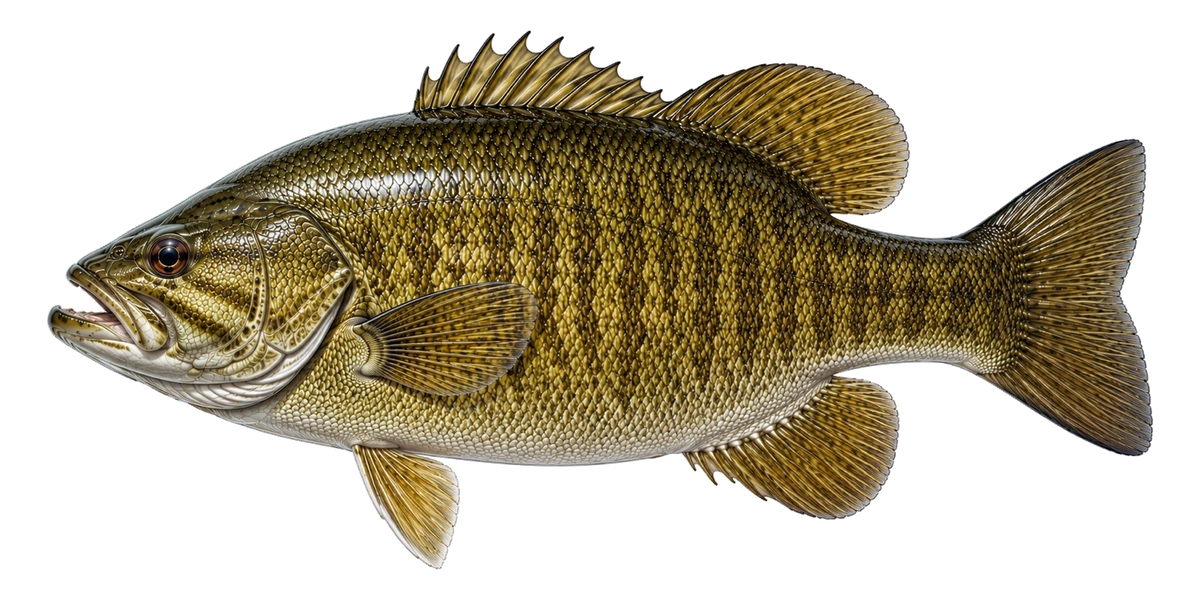
Smallmouth Bass Fishing at Lake Keowee
Micropterus dolomieuCentrarchidae · Cool-water black-bass sport predator
Smallmouth Bass are rock- and current-oriented black bass that often feed on crayfish, minnows and other prey around coarse bottom, points, boulders and current breaks. Clearer, cooler water and clean rocky habitat frequently put the fish and their food in the same place.
Start with the clues that concentrate fish
Look here
Start with habitat that combines clear cool water, rock and coarse gravel, and crayfish. Exact depth and location remain waterbody-specific.
Follow the food
Ambush-and-roam predator that uses rock, current breaks and prey disturbance to create feeding opportunities. Match the food actually present in the waterbody and season you are fishing.
How to fish for them
Crayfish-profile jigs and soft plastics.
Minnow-profile moving baits.
Tube and finesse presentations around rock.
Drifted or current-oriented presentations in river habitat.
Usable habitat depends on the combination of temperature, oxygen, season, and food rather than temperature alone.
Rock and coarse substrate can create feeding edges, current breaks, cover, or spawning habitat.
Crayfish becomes more useful when it overlaps with food, season, and usable habitat.
Moving water can concentrate food and create travel lanes or current breaks during seasonal transitions.
Points and ledges becomes more useful when it overlaps with food, season, and usable habitat.
Fast facts worth remembering
- Scientific name
- Micropterus dolomieu
- Family
- Centrarchidae
- Feeding style
- ambush-and-roam predator that uses rock, current breaks and prey disturbance to create feeding opportunities
- Primary habitat
- Rock, coarse gravel and current-influenced structure
- Major foods
- Crayfish and small fish
Facts that change how you think on the water
Rock is habitat and part of the food web
Smallmouth Bass repeatedly use rock, coarse gravel and clean bottom that create current breaks, nesting substrate and habitat for crayfish and aquatic insects.
Rock is more than cover—it is the food web
Smallmouth habitat repeatedly overlaps rock, coarse gravel and silt-free bottoms. Those surfaces create current breaks, nesting substrate and habitat for crayfish and aquatic insects, making the bottom itself part of the feeding system rather than just a place for fish to hide.
The mouth really is smaller
Adult Smallmouth Bass have a jaw that reaches only to about the rear margin or middle region of the eye rather than extending well beyond it like a largemouth. Their sides commonly show vertical bars instead of a continuous dark horizontal largemouth stripe, and the two dorsal fins are more clearly connected.
A male builds and guards the nest
As spring water warms, male Smallmouth Bass sweep nests over coarse gravel or rock in areas protected from excessive current and remain to guard eggs and fry.
A seasonal behavior, not a magic temperature
Smallmouth Bass spawn in spring when males build and guard nests over clean gravel, rock or other firm substrate. Exact timing varies with latitude and local warming.
Fishing use: As spring approaches, give clean gravel, protected rock and staging structure near spawning habitat more attention.
Keep in mind: The 60°F spawning cue is not a universal feeding-temperature rule.
Three facts that stick
Smallmouth have a different body shape, jaw proportion, habitat preference and feeding pattern, with rock and current playing a much larger role.
Smallmouth can exploit insects and crayfish exposed when turtles or suckers disturb the bottom.
Male Smallmouth Bass continue protecting young fish well after the eggs hatch.
Rock is both cover and groceries.
Smallmouth fishing gets simpler when rock, current and prey overlap. Crayfish, minnows and clean coarse bottom often explain the fish better than a calendar pattern by itself.