
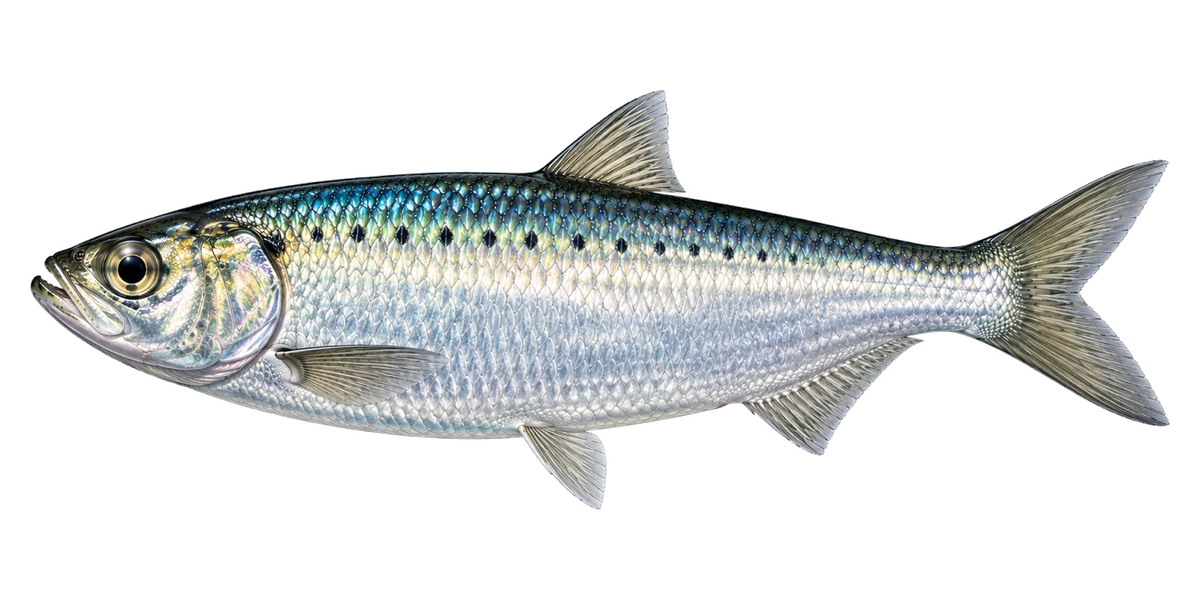
Blueback Herring Fishing at Lake Keowee
Alosa aestivalisAlosidae · Pelagic forage fish and anadromous river herring
Blueback Herring are schooling pelagic forage fish. Coastal populations migrate into freshwater to spawn, while landlocked populations can complete their life cycle inside reservoirs. For anglers, the key is movement: find the herring school, then ask which predators are tracking it.
Use the forage to find feeding predators
Look here
Start with habitat that combines dense pelagic bait schools, spring migration or spawning movement, and shoreline and hard-substrate spawning activity. Exact depth and location remain waterbody-specific.
What feeds them
Pelagic planktivore and opportunistic consumer of fish eggs and larvae. Match the food actually present in the waterbody and season you are fishing.
How to use them as a clue
Use sonar, visible flickering bait and surface activity to locate the herring concentration before choosing a fishing spot.
Birds, dimpling bait and sudden predator eruptions can reveal where a moving school has risen in the water column.
Spring warming, current and reservoir-scale movement can relocate herring quickly, so yesterday's bait location may not hold today.
Check above, below and along the edges of the herring school for predators rather than assuming they sit inside the densest bait.
Concentrated food can pull Blueback Herring into a much smaller part of otherwise similar water.
Spring migration or spawning movement becomes more useful when it overlaps with food, season, and usable habitat.
Shoreline and hard-substrate spawning activity becomes more useful when it overlaps with food, season, and usable habitat.
Concentrated food can pull Blueback Herring into a much smaller part of otherwise similar water.
Usable habitat depends on the combination of temperature, oxygen, season, and food rather than temperature alone.
Fast facts worth remembering
- Scientific name
- Alosa aestivalis
- Family
- Alosidae
- Feeding style
- pelagic planktivore and opportunistic consumer of fish eggs and larvae
- Coastal run cue
- Mid-50s °F
- Potential eggs/female
- Up to ~250,000
- Life-history forms
- Anadromous and landlocked populations
Facts that change how you think on the water
One species, two very different travel maps
Blueback Herring are naturally anadromous: coastal adults spend much of life at sea and return to freshwater rivers to spawn. Landlocked populations can complete the same species' life cycle entirely inside freshwater reservoirs.
A small forage fish can move an entire predator fishery
Blueback Herring form mobile schools that can become a major food source for striped bass, largemouth bass and other predators. A predator may follow the moving food mass instead of staying attached to one piece of structure.
Spring warming changes the map
Blueback Herring respond to spring warming with strong seasonal movement. Coastal fish migrate into freshwater rivers, while landlocked populations also redistribute within reservoirs.
They broadcast eggs instead of guarding a nest
Blueback Herring release large numbers of eggs in freshwater spawning areas. Eggs contact hard substrate and develop without the guarded nest behavior seen in bass and many sunfish.
Use Blueback Herring to read the predators
When Blueback Herring concentrates, it can reorganize predator location. Treat the forage itself as moving habitat, then verify which predators are actually using it.
Schools move the target
strong schooling behavior is central to both migration and forage value
Season can create a concentration
Spring spawning movement can concentrate Blueback Herring in river, tributary and shoreline corridors, but exact timing and routes vary by waterbody.
Usable water matters
spring warming is a major migration and spawning cue, but the exact threshold depends on latitude and life-history form
Match the real prey
Predators feeding on Blueback Herring respond to its real size, shape, speed, and schooling behavior.
Keep in mind: A Blueback Herring school does not prove a predator is feeding on it at that moment. Confirm predator presence with electronics, visible activity, bites, or other lake-specific evidence.
A seasonal behavior, not a magic temperature
Blueback Herring spawn in freshwater during spring. Coastal runs use river and tributary reaches with current and hard substrate, while landlocked populations can reproduce entirely within freshwater systems. Exact timing and locations vary by latitude and waterbody.
Fishing use: Use spring movement as a clue to where herring may concentrate, but let actual bait activity and local reservoir geography determine the fishing area.
Keep in mind: Do not assume every rocky shoreline holds spawning herring simply because water is in the mid-50s.
Three facts that stick
Although naturally anadromous, established landlocked reservoir populations can successfully reproduce entirely in freshwater.
Blueback Herring can produce hundreds of thousands of eggs during a spawning season.
A dark abdominal-cavity lining is one useful feature for separating Blueback Herring from similar river herring.
Find the herring. Then find the predators.
Blueback Herring are moving habitat. Their schools can pull predators away from obvious structure, so follow the bait first and then determine where predators are positioned around it.