
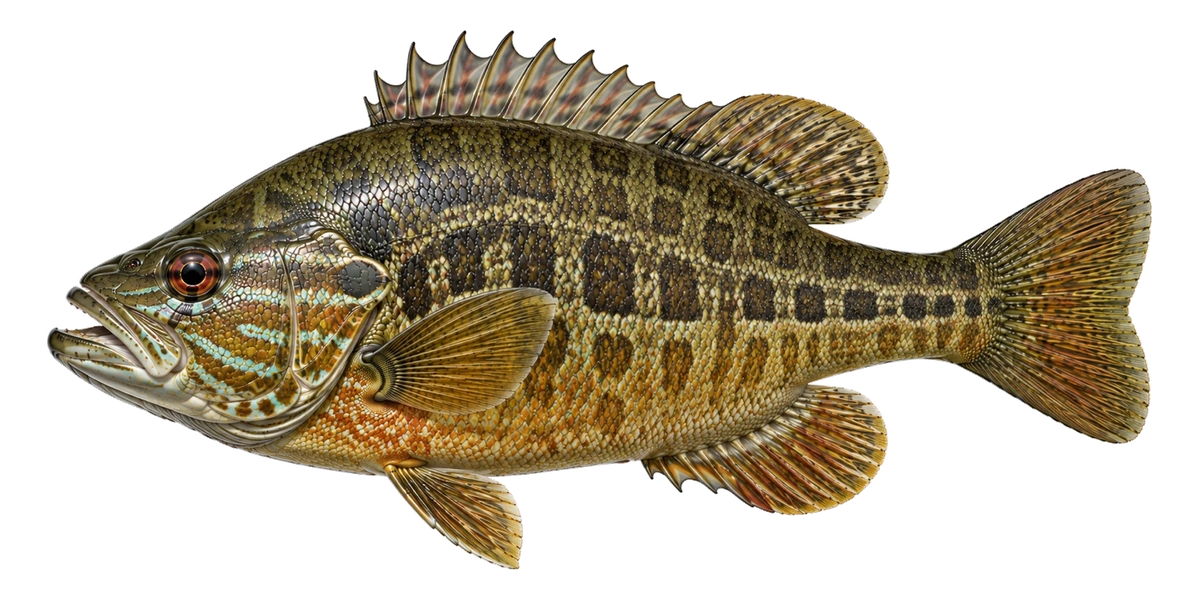
Bartram's Bass Fishing at Lake Jocassee
Micropterus pucpuggyCentrarchidae · Native upper-Savannah black bass and conservation-sensitive sport predator
Bartram's Bass are small, current-oriented black bass native to the upper Savannah River basin. They use rock, boulders, submerged wood, undercut banks and current breaks to intercept insects, crayfish and small fish. Because introduced black bass can hybridize with them, location and current fisheries evidence matter as much as appearance.
Start with the clues that concentrate fish
Look here
Start with habitat that combines rocky current breaks, boulders and submerged wood, and undercut banks. Exact depth and location remain waterbody-specific.
Follow the food
Structure-oriented visual predator using current breaks and cover to intercept available prey. Match the food actually present in the waterbody and season you are fishing.
How to fish for them
Small crayfish-profile lures.
Compact minnow or small-fish imitations.
Small topwater or insect-profile presentations where terrestrial prey is active.
Light jigs around rock and current seams.
Rock and coarse substrate can create feeding edges, current breaks, cover, or spawning habitat.
Rock and coarse substrate can create feeding edges, current breaks, cover, or spawning habitat.
Undercut banks becomes more useful when it overlaps with food, season, and usable habitat.
Rock and coarse substrate can create feeding edges, current breaks, cover, or spawning habitat.
Terrestrial insect activity in stream habitat becomes more useful when it overlaps with food, season, and usable habitat.
Fast facts worth remembering
- Scientific name
- Micropterus pucpuggy
- Family
- Centrarchidae
- Feeding style
- structure-oriented visual predator using current breaks and cover to intercept available prey
- Accepted name
- Micropterus pucpuggy
- Formally described
- 2025
- Native basin
- Upper Savannah River
Facts that change how you think on the water
A fish that officially became a species in 2025
Bartram's Bass was formally described as Micropterus pucpuggy in Zootaxa in August 2025. Genetic data and morphology showed that the Savannah River fish previously lumped with Redeye Bass represented a distinct evolutionary lineage.
A small native range makes identity matter
Bartram's Bass are native to the upper Savannah River basin of Georgia and South Carolina. Their restricted range makes population identity especially important where introduced black bass are present.
Its range is small enough to make identity important
Current taxonomic sources recognize Bartram's Bass from the upper Savannah River basin in Georgia and South Carolina. A fish with such a restricted native range can lose genetic distinctiveness much faster than a continent-wide species when nonnative relatives are introduced.
Hybridization is a conservation problem
Introduced Alabama Bass, Smallmouth Bass and related black bass can hybridize with Bartram's Bass. Introgression can persist even when a fish still looks mostly like the native form.
A seasonal behavior, not a magic temperature
Spawning occurs in spring to early summer, with males using coarse gravel and protected pockets near rocky stream habitat for nests. Exact timing varies with local conditions.
Fishing use: During the spawning period, coarse gravel and protected current pockets gain importance, but handle nesting fish with care in a conservation-sensitive population.
Keep in mind: Historical temperature and calendar guidance is regional. Use it as a seasonal clue, not a universal feeding rule.
Three facts that stick
For decades it was treated as a Redeye Bass form; modern genetics and morphology finally supported a separate species name.
Micropterus pucpuggy was published in August 2025 and is now accepted by major taxonomic catalogs.
Hybridization with nonnative black bass is a major threat because introgression can persist even when fish still resemble the native form.
Fish the current break, not just the rock.
Bartram's Bass live where rock, wood and current create short feeding opportunities. Insects, crayfish and small fish all matter, so look for the place where current delivers food without forcing the bass to fight it constantly.