
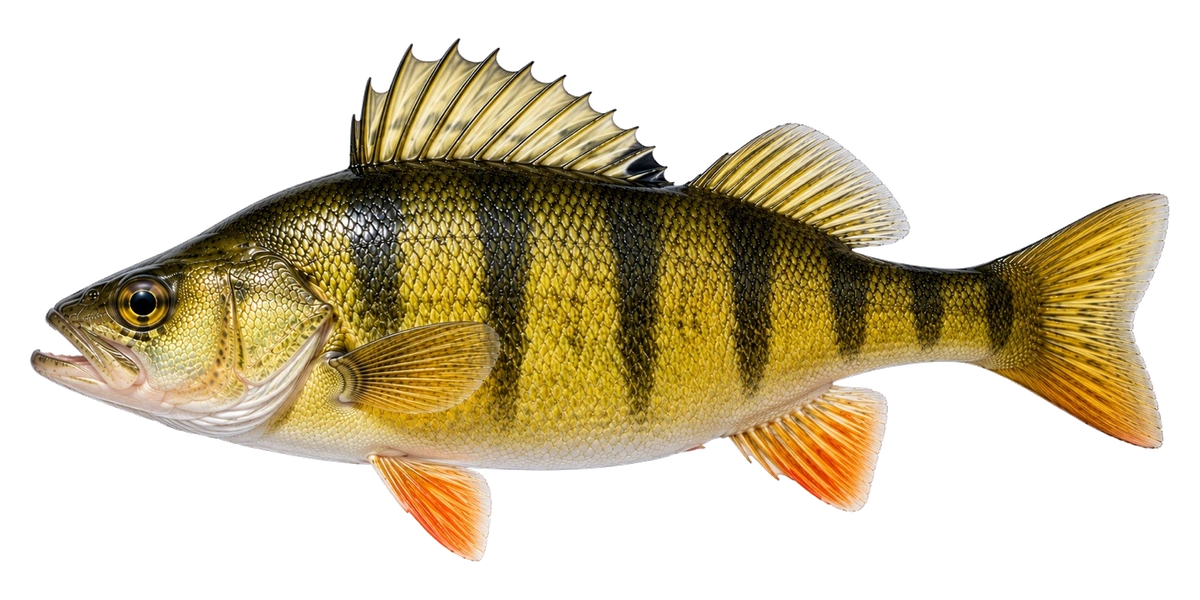
Yellow Perch Fishing at Lake Greenwood
Perca flavescensPercidae · Schooling sport panfish and forage predator
Yellow perch are mobile schooling panfish that can be shallow around spring cover, suspended or near bottom around prey, and progressively deeper as seasonal conditions change. The key is usually finding the school rather than becoming attached to one waypoint.
Start with the clues that concentrate fish
Look here
Yellow perch move. A productive location matters because the school is there, not because that exact coordinate must stay productive all season.
Follow the food
Diet changes with size. Larger perch increasingly use fish and crayfish, while younger fish rely more heavily on plankton and small invertebrates.
How to fish for them
Use sonar, visible activity and repeated bites to locate a concentration before spending too long on one piece of structure.
Small jigs, small minnows where legal, spoons and insect- or worm-sized baits match much of a perch's natural prey.
When a school is directly below the boat, compact vertical presentations can keep the lure in the productive depth band.
Give small-fish and crayfish profiles more attention while keeping the overall presentation compact.
Yellow perch can form large groups. When the marks or bites disappear, search again rather than assuming the fish stopped feeding.
Vegetation provides cover and invertebrate prey and becomes especially important around spring spawning habitat.
Rock, basin edges and drop-offs can concentrate both schools and prey.
Perch may seek cooler water as lakes warm, but deep cool water is useful only when dissolved oxygen remains adequate.
Vegetation, branches and other shallow cover become important when perch move toward spawning areas.
Fast facts worth remembering
- Scientific identity
- Perca flavescens
- Family
- Percidae — the perch family
- Behavior
- Strongly schooling
- Main foods
- Insects, crayfish and small fish
- Spawning style
- Long gelatinous egg ribbons; no guarded nest
- Identification
- Yellow body with dark vertical bars and relatively small mouth
Facts that change how you think on the water
Fish the school, not yesterday's waypoint
Yellow perch are strongly schooling fish and groups can shift location and depth.
The menu changes as they grow
Young perch use plankton and small invertebrates; larger perch increasingly eat insects, crayfish and small fish.
Cooler is not enough
Perch may move deeper toward cooler water, but deep habitat can become unusable if dissolved oxygen declines.
Spring changes the map
Perch move toward vegetation, submerged branches and other shallow structure to spawn.
A seasonal behavior, not a magic temperature
Yellow perch spawn communally in spring. Females release long gelatinous ribbons containing many eggs over vegetation, submerged branches and other structure; adults do not build or guard nests.
Fishing use: Search suitable shallow cover as schools move toward spawning habitat, but expect those concentrations to disperse afterward.
Keep in mind: A spawning temperature range is a reproductive clue, not a universal feeding optimum or permanent depth rule.
Three facts that stick
Thousands of eggs can be held in a long gelatinous, accordion-like strand draped over cover.
Unlike many sunfish, Yellow Perch do not build a nest or defend their eggs and young.
Yellow Perch can live far longer than their modest body size might suggest.
Find the school. Then stay with it.
Yellow perch are mobile panfish. Structure narrows the search, but the school itself is the target. Follow the fish, match their prey, and remember that cool water only helps when oxygen is usable.